
In 2024 I launched my first tech startup with two friends (other students at my university). It was an adventure and I learned a lot. We made some money but eventually shut down the business in December 2024 (in order to start a new one). Let me share the top 3 lessons I learned.
1 – A startup should solve a problem.
3 months in to our journey, I heard a quote from a successful entrepreneur – “Once you have product-market fit, you’ll know. It’ll feel like water flowing downhill.” He was talking about how if you really find a problem that people are facing, and build a solution that addresses that pain, it’ll be an easy product to sell.
Our startup approached a problem the wrong way – first we found a solution, then tried to find a problem that our solution would be good for. We learned about a technology called RCS, which basically makes text messages way better and more interactive. Here’s an example:
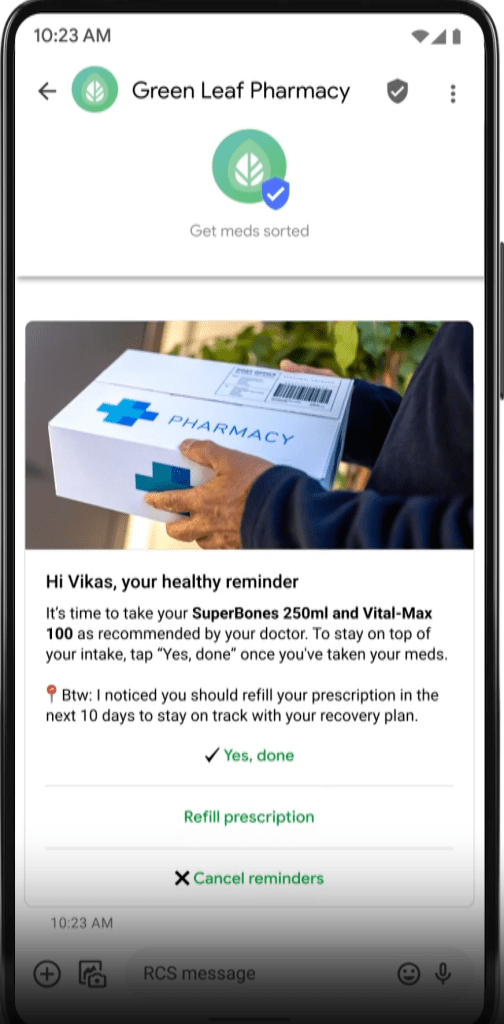
Basically you can tap your way through and experience instead of needing to type anything. We saw some studies that claimed it increased customer engagement by over 70% so we jumped right on it. The only issue: who would we sell it to? What would our product be?
We thought for a while about it and brainstormed different use cases. Maybe it could be for setting appointments. Maybe it could be for purchasing things online. Or maybe it could be used at a job fair or event, for digital business cards.
We brainstormed a lot and I now realize that brainstorming actually isn’t very useful. The most important thing is getting something out there and see if it solves a real problem. We ended up talking to some small home services businesses (like a window washing company), and they were really interested in the possibility of getting more reviews. So we drafted up a mockup of what it could do:
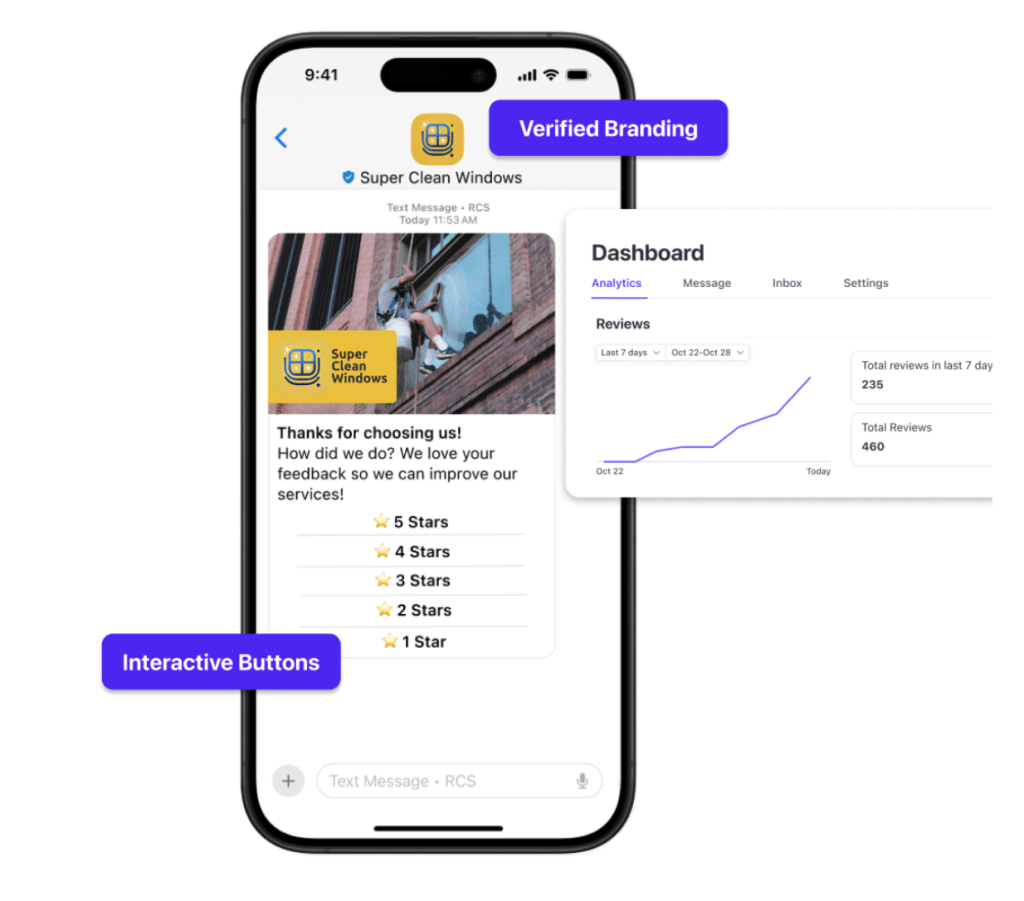
The people we showed it to really liked it, since they were currently paying their employees $10 a review that they got from customers. So we offered to charge $5 a review and they agreed. Now all we had to do was build the thing. Which leads me to lesson 2.
2 – Don’t promise the impossible.
We now had a goal: build a platform to send these custom messages to the customers of home services businesses to get more reviews for them. We had been looking into how to send RCS messages, and it turned out to be way more regulated and difficult than we originally thought. We got in talks with several companies that provided the service in a more general sense (like registering your business to be able to send the messaging at all), and realized that most of them were too big for us. They demanded a volume of 1 million messages per month, which we obviously wouldn’t be able to do.
We eventually found a company that was small enough to take us on. They told us that getting us registered to be able to send the messages would take about 2 weeks (this was in September), so I put in $3,000 of my own money for the initial deposit to use their software, and we got rolling.
We were super excited. We began building a website and coding out a prototype. I really enjoyed the process of taking this huge, vague problem and breaking it down in manageable pieces. I built an app where the user could log in, connect to their CRM (where they keep all their customer data), pull all the appointments for that day, and then customize and schedule messages to collect reviews. I also built a dashboard to track all the reviews coming in, as well as a way to see all past messages. I even built an auto-forwarder, so that when customers responded to our message, they would be redirected to the business owner who could address any questions. Within a month or so, our product was looking pretty useful. The only problem? We still couldn’t send RCS.

We were waiting and waiting. For the time being, we were just sending normal SMS messages, asking for reviews. And it was working! We were getting our customers around triple the amount of reviews that they were getting before. So they were happy. But we were growing increasingly disappointed with the slow pace things were moving on the RCS end. The company we had paid $3k to do this for us said it was out of their hands. Google and mobile carriers like Verizon had a long backlog of companies to approve, and we were so small that it looked like we might never get there.
All along the way, we kept calling small businesses and telling them about our product, trying to get them to try it out. We experienced success at first and built our way up to about 10 customers. But as the RCS approval dragged on and on, we lost our passion, and as a result, our sales suffered. We couldn’t feel good about selling RCS when in reality all we were doing at the moment was sending text messages that they could basically do themselves. In the end, we shut the business down in December. We couldn’t keep delaying it, and we were no longer hopeful that we would ever get approved.
We had generated enough money to break even on expenses and each pull out around $300 profit. One of the team members went to work for a different startup, and me and the remaining guy decided to try again with a different idea. So January – April 2025 will be exciting!
3 – Get users using it. ASAP.
So much of startup success is due to building something fast, getting validation, and seeing whether or not it works. This can only be done by seeing if people will use the product, pay for it, and recommend to others. If you wait until your product is perfect, you might have invested 3 months into something that nobody really cared about.
It’s an uncomfortable feeling to put your work in front of others when you know that it could be better. But failing fast is the key here. With limited time, speed is the most important variable.
Looking back, we actually did a pretty good job of getting customers using our product quickly. It wasn’t a super technically difficult product to build, so we were able to get messages sending out for people within the first few weeks. We saw results for reviews almost immediately, and these small wins fueled us to move forward. They also helped us know where to focus our efforts. When building a tech product, there are a million features that seem super cool, and maybe even important. But what I’ve learned is that there is usually one or two core features that users want, and the rest really don’t matter.
We should have focused more on the core feature of getting more reviews, and we should have gotten it in the hands of more customers. With 10 customers, making us around $500 a month, it was easy to give up. If we had managed to get 10,000 customers, generating $50,000 a month, we could have waited out the RCS approval. So, long story short, build and sell.
I’m going to take these lessons into my next startup and hopefully see greater success. All in all, I’m so grateful that I got to spend my last year of college working on a business. I’m learning so much real-world stuff and beginning to get an idea of how I want my next 10 years to go. I’ve definitely began incorporating startups into my strategy to become free by 35.
Thanks for reading. I’m going to be posting once a month in 2025. Stay tuned!
 Free By 35
Leave a comment